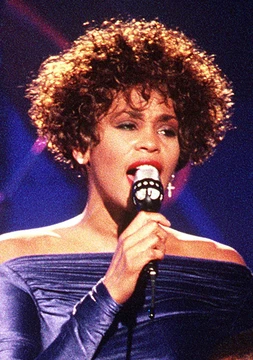
Michael Jackson
Two icons, one era, a friendship that transcended the stage.

The source only covers Whitney Houston's debut album, its release, chart performance, sales, awards, and the background and recording of the album. It does not discuss Michael Jackson or any relationship with him.
- Role
- Friend, cultural peer, and fellow icon in Houston's world
- Affiliation
- Music industry / global pop culture
- Era of prominence
- 1980s through 2000s
- Status
- Deceased (June 25, 2009)
- Notable connection
- Performed at Houston's memorial service, 2009
Lore & Background
The 1980s and 1990s produced a generation of artists whose names became synonymous with musical excellence, and Whitney Houston and Michael Jackson were arguably its twin pillars. Houston's powerhouse vocal ability and Jackson's revolutionary choreography and songwriting created a cultural moment where Black artists dominated the global pop landscape in ways previously unimaginable. Their paths crossed repeatedly at industry events, award ceremonies, and private gatherings, and both spoke in interviews about the other with a warmth and genuine affection that set them apart from the usual guarded politeness of celebrity circles. For Houston, Jackson represented something beyond professional respect. In a career built on emotional authenticity and vocal vulnerability, she found in him a peer who understood the weight of global expectation, the scrutiny of fame, and the relentless pressure to reinvent oneself. Their friendship, as understood by fans and observers, was grounded in shared experience: the same era, the same cultural battles, the same devotion to craft. It was a bond that did not require constant proximity to remain meaningful. When Jackson passed in the summer of 2009, Houston's presence at his memorial service became one of the most emotionally resonant images of that period. In a world of carefully managed celebrity reactions, her performance and visible grief spoke to a friendship that had endured for decades, and fans of Houston's story saw in that moment a confirmation of the depth of human connection beneath the spectacle of two of music's most iconic careers.
In Their Own Story
The backstage corridors of a major industry gala hummed with the low murmur of a hundred conversations, but in a quiet alcove near the catering tables, two figures stood apart from the crowd. One held a glass of water they hadn't sipped; the other shifted his weight from one foot to the other, a small, private smile playing at the corner of his mouth. They didn't need a script for this. No publicist had arranged the meeting. They simply found each other the way they always did—between the noise, in the small pocket of silence where two people who had carried the weight of the world's expectations could set it down for a few minutes. A nod. A laugh at something neither would ever repeat outside that room. Then the lights came back up, the cameras reappeared, and they were the icons again. But for those three minutes, they were just two friends, tired and glad, in a world that rarely let them be anything else.
Reader's Guide
Michael Jackson in the Whitney Houston narrative functions as the ultimate peer—a mirror held up to her own stardom, a confirmation that the heights she reached were shared by someone who understood them from the inside. He is not a rival in any antagonistic sense; rather, he is the other half of a cultural duet that defined an era. His role in Houston's story is that of a long-standing friend and fellow artist. Their relationship, as understood by fans, was built on mutual respect, shared cultural experience, and a genuine personal warmth that surfaced at public moments. He represents the world of 1980s and 1990s pop at its most electric—a world where two Black artists could simultaneously reshape the industry's center of gravity. His arc in this narrative is bittersweet. He is present throughout Houston's career as a constant, a familiar name in the same conversation. His departure in 2009 becomes a turning point in the emotional landscape of her later years, a loss that fans of Houston's story recognize as deeply personal. His presence at her own memorial in 2012, in the form of shared memories and the enduring cultural bond between their legacies, completes a circle that speaks to a friendship that outlasted even the boundaries of life. Defining moments for fans include their public appearances together, their mutual praise in interviews, and the deeply felt connection visible at Houston's 2009 memorial performance for him.
Did You Know?
- Whitney Houston performed at Michael Jackson's memorial service in the summer of 2009, a moment fans cite as one of the most emotionally powerful public displays of their friendship.
- Both artists were central figures in the 1980s cultural moment that permanently expanded the global reach of Black pop and R&B music.
- Houston and Jackson were frequently mentioned by each other in interviews with a warmth and specificity that distinguished their bond from typical industry courtesy.
- Their shared era produced a generation of fans who grew up with both artists as inseparable parts of their musical identity, creating a lasting cultural link between their legacies.
More in Characters
Related in Whitney Houston
Links follow this subject's own source article.
Elsewhere in the Whitney Houston universe
Spotted an error? Know more?
This is a living reference — every entry is fact-audited, and reader corrections feed straight into our audit queue. Suggest an edit · See this site's audit record