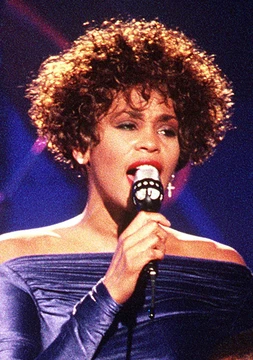
Diana Ross
The voice that crowned a generation before the next queen took the throne.

In the sprawling cultural universe that orbiting Whitney Houston's career, Diana Ross stands as a towering contemporary legend — a voice that defined an era of Black American music before Whitney's own rise and continued to shape the landscape alongside her. She is not a fictional creation but a real, living icon whose presence in the same world of soul, R&B, and cinematic crossover makes her an essential figure in any encyclopedia of the Whitney Houston era. Fans of Whitney's world often encounter Ross's name in the same breath — as the standard against which new vocalists were measured, as a fellow actress in the crossover space, and as a cultural touchstone of the same Black artistic lineage.
- character
- Diana Ross
- role
- Contemporary artist, cultural icon, and fellow legend in the Whitney Houston era
- affiliation
- The Supremes (originally); solo recording career; film acting
- status
- Living legend; active cultural figure
- discipline
- Vocal performance, acting, showbiz leadership
Lore & Background
Diana Ross entered the Whitney Houston universe as its elder architect. Her presence in the cultural conversation meant that any young singer reaching for the top of the charts was, consciously or not, stepping into a space Ross had already claimed and then expanded. The lineage is not merely chronological; it is tonal, stylistic, and deeply personal to the Black female artists who followed. Ross's transition from group leader to solo star in the early 1970s, and then into film with her landmark role in The Wiz (1978), created a template that Whitney would later walk in a different key. Both women crossed from recording studio to silver screen, both carried enormous public expectations, and both navigated the machinery of the entertainment industry with a blend of grace and ferocity. In the Whitney Houston universe, Ross is the 'before' that makes the 'after' legible — the proof that the path was possible. Fans who grew up on Whitney's 1985 debut album or the thunder of 'The Bodyguard' soundtrack often discover Ross through Whitney's own references, through the shared vocabulary of soul and pop, and through the simple fact that both women made the world stop and listen. In an unofficial encyclopedia of Whitney's world, Ross is the chapter you read to understand the stakes.
In Their Own Story
The backstage corridor smelled of hairspray and warm amplifiers. A roadie's radio crackled with a Motown classic, and for a breath the fluorescent lights seemed to dim into something golden. Diana Ross stood at the far end of the hallway, adjusting the strap of her gown, her eyes catching the reflection of a younger singer warming up in a green room down the hall. She didn't smile, exactly. She nodded — once, slowly — the way a lighthouse acknowledges a ship that has finally found the channel. Then she turned, heels clicking against the tile, and walked toward a stage that had been waiting for her voice for forty years. The younger singer finished her run, heard the corridor go quiet, and understood without a word: the torch had never been passed. It had been shared.
Reader's Guide
Diana Ross occupies the Whitney Houston universe as the elder legend, the generational predecessor whose career defined the template for the Black female superstar in both music and film. She is not a rival in any narrative sense but a foundation: the artist who proved that a woman could own a recording act, leave it, and build an even larger solo identity. Her skills are vocal precision, theatrical command, and an almost preternatural sense of showmanship. Where Whitney's power is often described as raw, breathless, and overwhelming, Ross's is architectural — every note placed, every gesture choreographed. In the shared world of 1980s and 1990s crossover, both women appeared on the same stages, in the same magazine spreads, in the same cultural conversations about what a Black woman's voice could do in a mainstream industry. Her presence in the Whitney Houston universe is the constant hum of 'this has been done before, and it was done magnificently,' a reminder that the throne Whitney sat in was one of many, and that the lineage stretches back further than any single career.
Did You Know?
- Diana Ross starred in the 1978 film The Wiz, a musical adaptation of The Wizard of Oz, which featured the song 'Home' — the same song Whitney Houston sang during her national television debut on The Merv Griffin Show in June 1983.
- Diana Ross was a member of The Supremes, Motown's flagship act, before launching a solo career in the early 1970s and later transitioning into film acting.
- Whitney Houston's mother, Cissy Houston, was a background singer for artists including Lou Rawls, Chaka Khan, and Herbie Mann — all of whom had connections to the same music circles as Diana Ross.
More in Characters
Related in Whitney Houston
Links follow this subject's own source article.
Elsewhere in the Whitney Houston universe
Spotted an error? Know more?
This is a living reference — every entry is fact-audited, and reader corrections feed straight into our audit queue. Suggest an edit · See this site's audit record