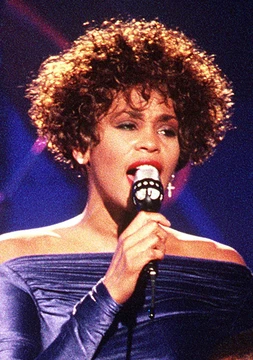
Dionne Warwick
The velvet voice that taught a generation how to feel a song before Whitney taught them how to shatter the glass.

via Wikipedia: Cissy Houston · see source
Dionne Warwick stands in the Whitney Houston universe as the towering, silver-haired matriarch of sophisticated soul and pop vocalism — the artist who paved the runway that Whitney would later strut down with thunderous power. Where Whitney's world is defined by raw, gospel-fueled belting and cinematic spectacle, Dionne represents the other great American female vocal tradition: refined, emotionally precise, and effortlessly elegant. She is the living bridge between the Motown/Atlantic golden age of the 1960s and the blockbuster era of the 1980s and '90s that Whitney came to dominate. For fans of Whitney Houston's story, Dionne is less a rival and more a kindred spirit from a different generation — proof that the throne of 'greatest female vocalist of her era' was never a single seat. She is the woman in the audience at an awards show, nodding with quiet recognition when Whitney hits that impossible high note, because she herself once made the world stop to listen.
- Role
- Contemporary legend; elder stateswoman of American female vocalism
- Affiliation
- Soul / Pop / R&B (1960s–present)
- Origin
- East Orange, New Jersey
- Status
- Living icon; Rock and Roll Hall of Fame inductee
- Relationship to Whitney
- Peer and generational predecessor in the great American female vocal lineage
Lore & Background
In the mythology of the Whitney Houston universe, Dionne Warwick occupies the role of the 'First Great Voice' — the woman who showed the world in the early 1960s that a Black woman's voice could be simultaneously a weapon and a lullaby. Her career, stretching back to the dawn of the modern pop era, established a template of emotional intelligence and technical mastery that every subsequent generation, including Whitney's, would measure themselves against. Fans often describe her as the 'quiet storm' to Whitney's 'thunderstorm' — both devastating, but in fundamentally different registers. The two artists never truly competed in the same lane. Dionne's world was one of sophisticated pop arrangements, witty lyrics, and a vocal delivery that could make a minor key sound like a confession. Whitney's world was Broadway-scale, gospel-amped, and unapologetically massive. Yet both shared a common ancestor in the church and a common enemy in the industry's tendency to box women into a single image. In fan lore, they are the two pillars holding up the temple of 'what a woman's voice can do.'
Dionne's longevity is itself a kind of magic in this universe. While Whitney's story is one of extraordinary, tragic brilliance compressed into a single blazing arc, Dionne's is the story of a voice that simply refused to go quiet. Decades after her peak, she is still singing, still writing, still showing up — a living rebuttal to the idea that a woman's prime has an expiration date.
In Their Own Story
The ballroom at the Grammys is half-dark, the chandeliers reduced to a warm amber glow. In the third row, a woman in a deep emerald gown watches the stage where a younger singer is delivering the performance of the night — the kind that makes the sound engineers wince and the audience hold its breath. The younger singer hits the final sustained note, and the room detonates. The woman in emerald does not clap. She simply closes her eyes, tilts her head slightly, and lets a small, knowing smile cross her lips. She has heard this before. Not this voice, not this song — but the feeling. The electricity of a human being pouring everything they have into a single breath and making the air itself vibrate. She opens her eyes, catches the younger singer's gaze across the crowd, and gives the tiniest nod. A queen acknowledging another queen. Then she turns to the woman beside her, murmurs something about the acoustics in this hall, and they walk out into the New York night, where a cab is waiting and the city hums its low, endless chord.
Reader's Guide
She is not a rival to Whitney but a parallel summit — a different mountain, a different path to the same sky. Her 'powers' in this world are emotional precision and vocal elegance. Where Whitney's gift is volume and gospel fire, Dionne's is the ability to make a whispered syllable carry more weight than a scream. She is the artist of the almost, the implication, the space between the notes. Her defining trait is longevity: she has outlasted trends, labels, and entire decades, remaining relevant through sheer force of artistic identity. Her arc is not one of rise and fall but of steady, unbroken presence. She entered the story before Whitney's chapter even began, and she is still in it. For fans, she represents the 'what if' and the 'what was' — the other possible shape of greatness. Her defining moments are not single events but a continuous thread: the first record in 1963, the Hall of Fame induction, the decades of touring, the quiet refusal to be retired. In fan discussions, she is the character you summon when someone says 'Whitney was the only one.' She is the counter-argument with a smile.
Did You Know?
- Dionne Warwick's career began in the early 1960s, making her a full generation ahead of Whitney Houston's rise in the 1980s — she was already a household name when Whitney was still a child in New Jersey.
- Both artists are from the New Jersey / New York corridor, sharing a regional musical DNA rooted in the church and the radio stations of the Northeast.
- Dionne Warwick was inducted into the Rock and Roll Hall of Fame, a recognition that places her in the same pantheon as the artists who defined the sound of mid-century America.
- In fan circles, the pairing of Dionne and Whitney is often described as 'the two great American female voices' — a duo that never shared a stage but shares a legacy.
More in Characters
Related in Whitney Houston
Links follow this subject's own source article.
Elsewhere in the Whitney Houston universe
Spotted an error? Know more?
This is a living reference — every entry is fact-audited, and reader corrections feed straight into our audit queue. Suggest an edit · See this site's audit record