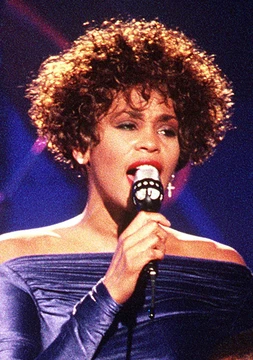
Mariah Carey
A five-octave siren who proved the era could hold two queens.

Mariah Carey is a towering figure in the Whitney Houston universe—a fellow vocalist, songwriter, and cultural force who entered the scene in the early 1990s and quickly established herself as one of the most distinctive voices of her generation. Where Whitney's world was defined by powerhouse belting and gospel-rooted soul, Mariah carved out a parallel lane built on crystalline melisma, orchestral pop arrangements, and an almost otherworldly upper register that made audiences sit up and listen. In this shared musical landscape, the two artists existed as parallel peaks of the same era: both women who commanded arenas, defined the sound of their decade, and carried the weight of an entire industry's expectations on their vocal cords. Mariah's presence in the Whitney Houston universe is that of a brilliant, sometimes turbulent contemporary—someone who proved the world could hold more than one kind of extraordinary voice at once.
- Role
- Contemporary vocalist, songwriter, and cultural icon of the Whitney Houston era
- First appears
- 1990 (debut single and self-titled album)
- Affiliation
- Columbia Records (primary label through most of her career)
- Signature trait
- Five-octave vocal range with signature melismatic runs
- Status
- Active artist and cultural presence
Lore & Background
In the Whitney Houston universe, the early 1990s were a time when the pop-R&B sky felt impossibly crowded with genius. Whitney had already cemented her place as the voice of a generation, and the world expected the throne to be singular. Her debut single arrived with a kind of effortless, almost whispered confidence, and the melismatic runs in its bridge made radio engineers and casual listeners alike stop and rewind. She did not imitate the existing queen; she simply demonstrated there was another way to make a ballad feel like it was being sung from inside a cathedral. Her career in this universe became a long, glittering, sometimes stormy arc. She produced her own material, wrote her own songs, and insisted on an artistic identity that blended R&B, pop, hip-hop, and orchestral grandeur in ways that felt ahead of the moment. She released a holiday record that became a seasonal institution. She headlined films. She sat in judges' chairs on television. Through every shift in the industry's landscape, her voice remained the constant—a five-octave instrument that could hit a note so high it seemed to leave the atmosphere, then drop back down into a warm, conversational register as if nothing had happened. In the Whitney Houston universe, the relationship between the two women is one of mutual recognition among peers. They existed in the same rooms, on the same stages, in the same cultural conversation. Neither diminished the other. The era's fans were lucky enough to have both, and the music world was richer for the tension and the harmony between their very different approaches to the same fundamental act: putting a human voice in front of a microphone and making the world feel something.
In Their Own Story
The studio was quiet in a way that only exists at 2 a.m., when the session musicians have gone home and the engineer has stopped pretending to check levels. Mariah sat on the edge of the vocal booth, bare feet on the cold tile, a glass of water sweating condensation in her hand. She had been running the same bridge for an hour. Not because it was hard—she could hit the top C in her sleep—but because the phrasing felt like it belonged to someone else. She hummed a new run, let it hang in the air, then whispered, 'Again.' The engineer, half-asleep behind the glass, nodded. The tape rolled. And this time, the note that came out of her wasn't the one on the sheet. It was higher, stranger, a little broken at the edge like a glass bell struck too hard. She closed her eyes. The engineer stopped breathing. In the control room, the faders didn't move for a long time. Nobody needed to. The take was already perfect, and they both knew it.
Reader's Guide
Who she is: Mariah Carey is a vocalist, songwriter, and producer who occupies the role of the era's parallel genius in the Whitney Houston universe. She is not a rival in the petty sense; she is a different frequency of the same phenomenon. Her arc is one of a young artist who arrives with a fully formed artistic vision and spends decades defending it against an industry that keeps trying to sort her into a single genre. Her role and arc: She enters the scene in 1990 with a debut that announces her as something new. Through the 1990s and beyond, she builds a catalog that spans pop, R&B, hip-hop, and orchestral work, often producing and writing her own material. Her arc includes triumphs, public turbulence, reinventions, and a persistent refusal to be reduced to a single image. She is the artist who will hit the impossible note and then immediately drop into a conversational whisper, as if to say the power was never the point—the feeling was. Powers and skills: Her defining instrument is a five-octave range with a signature melismatic style that turns a simple syllable into a cascading run. She is also a skilled songwriter and producer, shaping her own sound rather than waiting for it to be handed to her. Her ear for melody and her instinct for orchestral arrangement set her apart from purely rhythmic or belt-driven artists. Defining moments (spoiler-aware): Her 1990 debut single that announced a new voice to the world. The holiday record that became a seasonal fixture in millions of homes. The mid-2000s comeback single that reminded everyone she could still top the charts. Each moment reinforces the same truth: the voice is still there, still strange, still hers.
Did You Know?
- Mariah Carey is widely cited as having a five-octave vocal range, making her one of the most technically expansive voices in popular music history.
- Her 1994 holiday album 'Merry Christmas' became a perennial seasonal release, selling millions of copies over decades and becoming a cultural fixture of the winter months.
- She is known for writing and producing much of her own material, maintaining a high degree of artistic control over her sound throughout her career.
- In the Whitney Houston universe, her entry into the scene in 1990 meant that the early 2000s audience had two generational vocal icons to celebrate simultaneously.
More in Characters
Related in Whitney Houston
Links follow this subject's own source article.
Elsewhere in the Whitney Houston universe
Spotted an error? Know more?
This is a living reference — every entry is fact-audited, and reader corrections feed straight into our audit queue. Suggest an edit · See this site's audit record