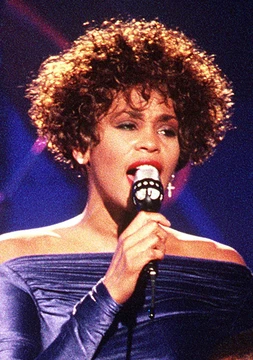
The American Music Awards
Where the crowd's heartbeat becomes a trophy, and Whitney's name echoes back from the audience.

The American Music Awards (AMAs) are an annual music industry ceremony that has served as one of the most significant recurring stages in Whitney Houston's career. Often billed as the 'People's Choice Awards of Music,' the AMAs are voted on by fans rather than industry peers, making them a unique barometer of public adoration. For Whitney, the AMAs were less a formality and more a homecoming—a place where the audience's love was made visible, quantified, and celebrated under the bright lights of a Los Angeles stage. In the Whitney Houston universe, the AMAs function as a recurring 'faction' in the broader narrative of her rise and sustained dominance in popular music. They represent the moment where a performer's connection to the public is formally acknowledged, and Whitney's repeated presence there—both as winner and performer—cemented her status as an artist whose fanbase was not just loyal but vocal and mobilized.
- Type
- Annual music awards ceremony
- Founded by
- Dick Clark
- Motto
- The People's Choice Awards of Music
- Typical venue city
- Los Angeles, California
- Voting method
- Fan-voted (public polls)
- Whitney Houston's relationship
- Multiple-time winner and performer
Lore & Background
The AMAs occupy a singular place in Whitney Houston's professional mythology. Unlike the Grammys, which carry the weight of critical prestige, the AMAs speak in the language of the street, the radio dial, the kitchen-table conversation. When Whitney's name was called on that stage, it was not a committee of judges bestowing approval—it was millions of ordinary listeners saying, in unison, 'this is ours.' For an artist who built her career on the sheer physicality of her voice, that democratic validation carried a particular emotional weight. Her early appearances at the ceremony marked the moment the world stopped calling her 'the new thing' and started calling her a force. The AMAs became a ritual in her career calendar: the red carpet, the specific weight of the trophy in her hands, the performance segments where she could let the voice run free without the constraints of a studio session. Fans remember these nights not just for the wins but for the performances—moments where the ceremony's production design became a backdrop for something that felt almost sacred. In the broader Whitney Houston narrative, the AMAs represent the axis around which her public identity turned. They are the recurring chapter heading in the fan-encyclopedia of her life: the place where the story of one extraordinary voice meets the collective story of everyone who fell in love with it.
In Their Own Story
The ballroom in Los Angeles hums with the particular electricity of a sold-out awards show. Somewhere in the wings, a pair of sequined boots is being checked for scuff marks. The stage lights are still warm from the previous act, casting amber pools across the polished floor. Then the announcement: her name, her category, the room inhaling all at once. She walks out not to applause but to a sound like the ocean finding its shore—thick, layered, unmistakable. The trophy is smaller than the moment. She holds it up, and for three seconds the entire audience is a single organism breathing in and out. The cameras catch the way her jaw tightens, the way her eyes find the front row, the way the microphone cord swings like a pendulum in slow motion. The ceremony will be on television by Sunday. But tonight, in this room, it belongs to the people who voted. And she belongs to them.
Reader's Guide
The American Music Awards function as a recurring institutional 'faction' in the Whitney Houston universe. Their stated purpose is to honor the year's most popular artists across genres—pop, R&B, rock, country, gospel—through a fan-voted process. This democratic mechanism distinguishes them from peer-judged ceremonies and positions them as a direct line between the artist and the public. Key 'members' in the context of Whitney's story include the ceremony's producers, the broadcast network crew, the presenting hosts, and—most critically—the voting fanbase itself. Whitney Houston's role within this faction is that of a perennial honoree and performer: someone whose name on the ballot is not a surprise but an expectation, and whose live performances become the night's emotional centerpiece. In terms of 'conflict' or narrative tension, the AMAs represent the pressure of public expectation. Every appearance is a test: can the voice deliver under the specific acoustics of a ballroom, the scrutiny of live television, the weight of a fanbase that has already decided she is the standard? The ceremony is both celebration and examination, a stage where the myth of the artist is stress-tested in real time. Whitney's repeated triumphs there are the story's recurring proof that the myth held.
Did You Know?
- The AMAs were conceived by Dick Clark, the same entertainer behind the American Bandstand and Rock & Roll Hall of Fame ceremonies, making them part of a broader ecosystem of American music celebration.
- Unlike the Grammys, where voting is conducted by industry members, AMA categories are determined by public fan polls, meaning Whitney's wins there reflected raw audience enthusiasm rather than peer respect.
- Whitney Houston's early AMA wins in the mid-1980s helped establish her as a mainstream crossover force almost immediately after her debut, compressing a career trajectory that might otherwise have taken years.
- The AMAs have historically been one of the few major ceremonies where a single artist can win multiple categories in one night, making Whitney's multi-trophy nights especially memorable to fans.
More in Factions & Groups
Elsewhere in the Whitney Houston universe
Spotted an error? Know more?
This is a living reference — every entry is fact-audited, and reader corrections feed straight into our audit queue. Suggest an edit · See this site's audit record