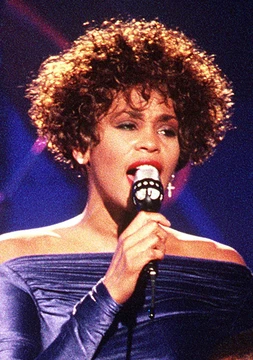
The Grammy Hall of Fame
Where Whitney's voice outlives the chart and becomes history.

The Grammy Hall of Fame is a permanent collection of landmark recordings maintained by the Recording Academy, honoring songs and albums that are at least 25 years old and recognized for their qualitative and historical significance to the recorded-music landscape. For Whitney Houston, it represents one of the most enduring validations of her artistry: her recordings continue to be inducted decades after their original release, cementing her place in the canon of American popular music alongside the very legends she sang about. In the Whitney Houston universe, the Hall of Fame functions as a kind of afterlife for her voice. While she passed in 2012, her inducted tracks keep earning new audiences, new generations of listeners, and new critical attention. The institution is not a person or a band, but it operates in fan culture almost like a guardian body—selecting, preserving, and re-presenting her work to the world.
- Type
- Recording honor / institutional collection
- Maintained by
- The Recording Academy
- Eligibility rule
- Recordings must be at least 25 years old at time of induction
- Whitney Houston inductions
- Multiple (including 'I Wanna Dance with Somebody (Who Loves Me)' and 'I Will Always Love You')
- Significance for Whitney
- Posthumous recognition of songs that defined 1980s–90s pop and R&B
Lore & Background
The Grammy Hall of Fame operates on a simple but powerful principle: time is the ultimate critic. A song must survive a quarter-century of cultural turnover, format shifts, and generational amnesia before a committee of peers deems it worthy of permanent enshrinement. Whitney Houston's inductees—most notably the 1987 dance-floor anthem 'I Wanna Dance with Somebody (Who Loves Me)' and the 1992 tear-jerker 'I Will Always Love You'—passed that gauntlet not by luck but by sheer gravitational pull. They were not merely hits; they were the soundtracks of a decade's emotional vocabulary, the songs people played at weddings, funerals, first cars, and last goodbyes. What makes Whitney's relationship to the Hall of Fame particularly resonant for fans is the posthumous dimension. She was gone before several of her recordings became eligible, meaning the institution is, in a sense, the one that keeps saying her name in public spaces. Each induction ceremony is a small resurrection: a committee reads her title aloud, a plaque is affixed, and the recording enters a permanent library. For a fan community that lost its icon at 48, those moments carry a weight that goes beyond industry recognition. The Hall of Fame also contextualizes Whitney within a lineage. She sits alongside recordings by artists she herself covered, artists she influenced, and artists who will never know her name. In that collective, her voice is neither the loudest nor the most technically complex, but it is arguably the most emotionally direct—a quality the committee, in its selections, seems to prize as much as innovation.
In Their Own Story
The ceremony room smells like fresh-cut flowers and old vinyl. The plaque reads a title in clean serif type. He steps back, adjusts his tie, and checks his phone. In the back row, a woman in her thirties—Whitney's daughter, or someone who looks like her—watches the plaque catch the overhead light. She doesn't clap. She doesn't need to. The song is playing somewhere in the building, muffled by a wall, and for eleven minutes the room belongs to a voice that no longer draws breath. The committee member locks the door. The plaque stays.
Reader's Guide
The Grammy Hall of Fame is not a band, a label, or a fan club. It is an institutional honor administered by the Recording Academy, and its 'membership' consists of inducted recordings rather than living people. Its goal is singular: to identify, from the vast archive of recorded music, those works that have demonstrated lasting qualitative and historical significance after at least 25 years. In the Whitney Houston narrative, the Hall of Fame serves as the long-game validator. Whitney won five competitive Grammys during her career, but the Hall of Fame operates on a different timeline—decades, not seasons. Her inducted tracks ('I Wanna Dance with Somebody (Who Loves Me),' 'I Will Always Love You') are selected by peer committee, not by fan vote, which lends them a particular authority in the eyes of skeptics. The 'conflict' in this faction's story is against forgetting. Every year, new recordings flood the market; the Hall of Fame's role is to say, 'These specific tracks matter, and they will matter in fifty years.' For Whitney's legacy, that role is existential: it is the mechanism by which her voice is kept in institutional memory long after the last radio station drops her playlist. Members of the Hall of Fame (i.e., the inducted recordings) are displayed in the Recording Academy's physical and digital archives. Whitney's entries sit alongside those of Aretha Franklin, Stevie Wonder, and countless others, forming a constellation of American song that fans treat as a sacred text.
Did You Know?
- Whitney Houston's inducted recordings were selected by a committee of Recording Academy members, not by public vote, making them a form of peer-reviewed canon.
- Because the Hall of Fame is a permanent collection, Whitney's inducted tracks will remain in the archive indefinitely—there is no 'removal' process, making the honor effectively irreversible.
More in Factions & Groups
Elsewhere in the Whitney Houston universe
Spotted an error? Know more?
This is a living reference — every entry is fact-audited, and reader corrections feed straight into our audit queue. Suggest an edit · See this site's audit record