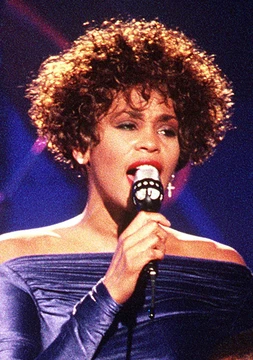
Dolly Parton
The songwriter whose words became the most beloved voice of a generation.

She is the voice behind the words that Whitney Houston would later transform into one of the best-selling singles in recorded history, making her an indispensable figure in the story of that era's pop and soul landscape. Beyond that singular connection, Dolly Parton stands in this world as the original artist who wrote and recorded the song, and whose suggestion to add the third verse from her 1974 original version shaped the final recording that became a global phenomenon.
- Role
- Songwriter / Fellow Artist / Cultural Icon
- Genre
- Country, Folk, Pop
- Affiliation
- Nashville / Country Music tradition
- Status
- Active
- Known For
- Songwriting, iconic stage persona
Lore & Background
That composition would travel forward two decades, landing in the hands of a young Whitney Houston preparing for the soundtrack to The Bodyguard. The result became the defining track of Whitney's career and one of the most recognized vocal performances of the 1990s. In this world, Dolly is thus the quiet architect behind the loudest, most emotionally charged moment of Whitney's story. Her broader presence in the universe is that of a peer and a contrast. Where Whitney's world is the glittering, high-fidelity world of global pop and soul, Dolly's is the warm, handcrafted world of Nashville songcraft, honky-tonk storytelling, and self-made showmanship. Their occasional shared stages—award shows, charity concerts, festival headliners—become moments where two different musical universes briefly overlap, and fans of both artists feel the electricity of that collision. Dolly also embodies a form of creative generosity that resonates throughout the Whitney Houston universe: the idea that a song written in a small Tennessee bedroom can outlive its original singer by decades and become the signature of an entirely different artist. She is the proof that in this world, the songwriter's hand is as sacred as the singer's voice.
In Their Own Story
The studio in Nashville was quiet except for the hum of a tube amplifier. Dolly sat cross-legged on the couch, a half-empty glass of sweet tea sweating on the coffee table, a yellow legal pad open on her knees. She'd been turning the same four chords over in her head since morning—something about a door closing, about love that doesn't ask to be kept. She hummed it low, almost to herself, and the words came in a rush, spilling onto the pad in her looping cursive. She didn't know yet that twenty years from now, a woman in a sequined gown would stand under a single spotlight in a London theater and make the whole world weep to those same words. She just knew the song was finished. She took a sip of tea, smiled at nothing, and started on the next one.
Reader's Guide
Dolly Parton is the legendary songwriter and country-music icon who occupies a unique position in the Whitney Houston universe: she is the author of the words that became Whitney's most iconic vocal performance. Her role is that of the creative wellspring. In 1992, Whitney Houston's cover of that same song for The Bodyguard soundtrack became a global phenomenon, one of the best-selling singles ever released. Dolly thus sits at the origin point of Whitney's most emotionally defining moment, a quiet but essential figure in the story. As a character in this universe, she is defined by self-made artistry, boundless generosity, and an almost mythic stage presence. Her skills are songwriting, vocal performance, and an intuitive understanding of melody and narrative that transcends genre. She moves between country, folk, and pop with ease, and her philanthropic work adds a layer of warmth and purpose. She is the universe's reminder that behind every great performance, there is often a writer who trusted the song to find its truest voice.
Did You Know?
- Parton suggested that Whitney Houston add the third verse from her 1974 original version, which had been a recitation that country radio programmers chose not to play.
- The song was covered by Linda Ronstadt in 1975 on her album Prisoner in Disguise, which inspired the version that Houston eventually recorded.
- Parton contacted producer David Foster prior to the studio recording to suggest Houston fully sing the third verse, which Houston learned within minutes and added her own vocal arrangement.
More in Characters
Related in Whitney Houston
Links follow this subject's own source article.
Elsewhere in the Whitney Houston universe
Spotted an error? Know more?
This is a living reference — every entry is fact-audited, and reader corrections feed straight into our audit queue. Suggest an edit · See this site's audit record