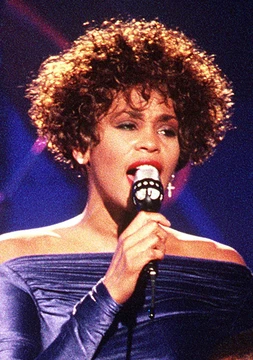
I Will Always Love You (Dolly Parton)
A country goodbye that became the world's most powerful goodbye, sung in a voice that could split the sky.

"I Will Always Love You" is the song at the emotional heart of Whitney Houston's career and, by extension, the entire Whitney Houston fan universe. For fans, the song is less a track and more a living artifact—the sound of a voice breaking open a room, of farewell rendered in pure, unbroken melody. In the lore of the Whitney Houston world, the song represents the moment a country songwriter's tender goodbye was lifted into the stratosphere by a vocalist whose range and control turned a simple declaration into something almost sacred. It is the track fans reference when they talk about what a voice *can* do, and it remains the single most requested, most replayed, most emotionally charged piece of music in the entire catalog.
- Songwriter
- Dolly Parton
- Whitney Houston version
- 1992, *The Bodyguard* soundtrack (pop/R&B power ballad)
- Associated film
- The Bodyguard (1992)
- Original genre
- Country
- Whitney version genre
- Pop / R&B
- Cultural status
- One of the best-selling singles in recorded-music history
Lore & Background
She has spoken in interviews about how the lyrics grew out of her long, close friendship with country star Porter Wagoner—a relationship built on mutual respect, shared stage time, and an easy, warm bond that made the prospect of parting feel genuinely painful. The song was not a love song in the romantic sense; it was a farewell between two people who had given each other years of creative and personal companionship. That specificity gave the lyrics a grounded, aching honesty that no amount of vocal power could replace. When the producers of *The Bodyguard* in 1992 looked for a song that could carry the film's emotional climax, they sought out Parton's catalog. Arif Mardin arranged the track for Whitney, stripping away the twang and the fiddle, replacing them with a slow-building orchestral bed and a vocal arrangement that let Houston start in a near-whisper and climb, step by step, into the upper register where the song becomes less a performance and more a declaration. The result was a version that felt like the original's spirit translated into a different language—still a goodbye, still tender, but now carried on a voice that could sustain a single note for what seemed like minutes. In the Whitney Houston fan community, the song occupies a almost mythic space. It is the track people play at weddings, at funerals, at the end of long nights when they need to feel something enormous. Fans often describe hearing Whitney's version for the first time as a moment of recognition—the feeling that the song had been waiting for that specific voice, that the words and the instrument were made for each other. Dolly Parton herself has acknowledged the special place Whitney's rendition holds, and the two women's relationship around the song—writer and interpreter, country and pop, the original and the echo—remains one of the most celebrated creative pairings in popular music.
In Their Own Story
The stage lights had just dimmed to a single warm amber, the kind that makes the air look like honey. Whitney stood at the microphone, one hand resting lightly on the stand, the other hanging loose at her side. The audience was so quiet you could hear the hum of the amplifiers. She didn't rush. She let the first two bars of piano breathe, let the room settle into the shape of the silence. Then her voice came in—low, almost conversational, like she was telling one person in the front row a secret she'd been carrying for years. And slowly, with the patience of someone climbing a staircase in the dark, she rose. By the final sustained note, the amber light seemed to pulse in time with the vibration in the floor, and somewhere in the third row, a woman pressed her hand over her mouth and let the sound take her somewhere she hadn't been in a long time.
Reader's Guide
Understanding "I Will Always Love You" in the Whitney Houston universe means understanding two songs that share a melody but live in entirely different emotional registers. It's a song you hear in a kitchen, over coffee, with a fiddle in the background and a voice that sounds like it's telling you the truth because it has to. Whitney Houston's 1992 version, recorded for *The Bodyguard*, transforms that same skeleton into a cathedral. The arrangement builds slowly, almost painfully, and the vocal performance is structured like a climb: each phrase sits a little higher, a little more exposed, until the final lines are delivered with a full-throated power that makes the earlier restraint feel like a held breath. The song became inseparable from the film's narrative of love, loss, and protection, and it carried Whitney's name to a global audience that may not have known her work before that moment. For fans navigating the Whitney Houston catalog, this song is the Rosetta Stone. It explains why people talk about her voice the way they do—because this track, more than any other, demonstrates the full architecture of what she could do: the control, the range, the emotional honesty, and the sheer physicality of a voice that could fill a stadium and still sound like it was speaking to one person.
Did You Know?
- Whitney Houston's version was produced by Arif Mardin, who restructured the arrangement to build gradually from a near-spoken intro to a full-throated climax, a design choice that made the vocal performance feel like a s
- Dolly Parton has publicly expressed that she is proud of Whitney's version and sees it as a natural extension of the song's emotional core rather than a replacement, a sentiment that fans often cite when discussing the s
More in Lore & History
Elsewhere in the Whitney Houston universe
Spotted an error? Know more?
This is a living reference — every entry is fact-audited, and reader corrections feed straight into our audit queue. Suggest an edit · See this site's audit record