I Have Nothing
A power ballad of total devotion, written from a real-life diva's experience and delivered by Whitney Houston at her peak.

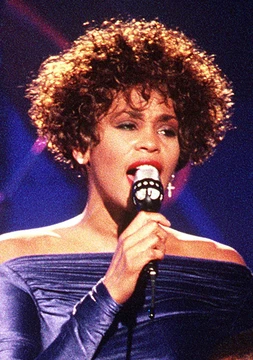
"I Have Nothing" is a song by American singer and actress Whitney Houston, released on February 23, 1993, as the fourth single from *The Bodyguard* (1992) by Arista Records. The power ballad was written by David Foster and Linda Thompson, and produced by Foster. The song was lyrically inspired by Thompson's earlier relationship with American rock singer Elvis Presley while musically, Foster was inspired by the music of Janis Joplin to compose the song. It was recorded later in the process for the soundtrack to *The Bodyguard* and was performed in the film itself. The song became an instant hit following its release, peaking at number four on the US Billboard Hot 100, number one on the US Cash Box Top 100 and was certified platinum and later 2× Platinum by the Recording Industry Association of America.
- Artist
- Whitney Houston
- Songwriters
- David Foster & Linda Thompson
- Featured in
- The Bodyguard (1992 film)
- Peak chart position
- #4 – Billboard Hot 100
- Genre
- Power ballad / Pop
Verified Timeline
Lore & Background
In the making of *The Bodyguard*, the film initially featured no music, which concerned Houston's label head, Clive Davis. He sent a letter to Kevin Costner and director Mick Jackson, and eventually Houston signed a deal to record content for the soundtrack. Houston agreed to record six songs, all six of which would be prominently featured in scenes from the film. In 1992, after recording 'Queen of the Night', Houston headed to Encore Studios in Burbank, California to begin working with David Foster on 'I Have Nothing'. According to Foster, the singer did warm up before recording, though she initially was concerned about the song's pitch, complaining she 'couldn't hit the note' and asked if he could drop the pitch down to a lower key. Foster told her he wouldn't be able to change the pitch for artistic reasons. Houston reportedly sipped green herbal tea before laying down her vocal. According to Jordin Sparks, Houston explained to her that she was pregnant at the time of the recording and just recorded three takes of the song. The lyrics were written by Foster's wife Linda Thompson, who in her 2016 memoirs revealed that the line 'Stay in my arms if you dare / Or must I imagine you there / Don't walk away from me' was inspired by her relationship with Elvis Presley, whom she dated between 1972 and his death in 1977. Thompson said, 'having lived with the very biggest male diva of all time, I had a good deal of experience to draw on while creating that lyric.'
In Their Own Story
In April 1991, Houston announced she was to begin filming her first movie, *The Bodyguard*, with Kevin Costner as co-star. After her I'm Your Baby Tonight World Tour wrapped up in October, producers set the date for principal photography on November 25, 1991. The romance thriller initially featured no music, which concerned Clive Davis. Costner agreed with Davis' concern, and through Warner Bros. Pictures, Houston eventually signed a deal to record content for the film's soundtrack in which she would earn royalties. Houston, along with Davis, would serve as executive producer on the album. The song was recorded at Encore Studios in Burbank, California on November 12, 1991. Foster was inspired by Janis Joplin's 'Piece of My Heart' to compose the song. Thompson wrote the lyrics centered around the character of Rachel Marron, describing her as 'this gorgeous megastar. She's petulant. She's a diva. And she has this bodyguard, he's protecting her, but she's difficult. And then she starts to fall in love with him. And the song has to be called "I Have Nothing."' Much like 'I Will Always Love You', Houston performed the song in the film and later the music video at the Fontainebleau in Miami Beach.
Reader's Guide
What it is: A pop and R&B song with soul elements, written in ternary form with a 'moderately slow' tempo of 52 beats per minute, initially set in the key of G major. The verse follows a G—Em7—C—Bm7—Am7—C/D chord progression. The bridge shifts to the relative minor key of E minor, while the first two choruses modulate to the parallel minor of G minor. Led by a vocal peak, the final chorus modulates to G# minor, before shifting to its relative major, B major. Houston's vocal range goes from the low note of G3 to the high note of F♯5. How it was received: Stephen Thomas Erlewine from AllMusic complimented the song as a 'first-rate urban pop song that skillfully captures Houston at her best.' Larry Flick from Billboard called it a 'booming power ballad' with 'the same lung-bursting drama' as 'I Will Always Love You.' Jan DeKnock of Chicago Tribune said it is 'yet another scorcher of a ballad.' Dave Sholin from the Gavin Report complimented Houston's 'emotionally-charged performance.' James Masterton wrote, 'A classic ballad like the Whitney we used to know and love showing her voice off to best effect.' Howard Cohen from The Miami Herald remarked that Houston 'soars effortlessly as she belts out the brass-inflected ballad.' Alan Jones from Music Week declared it as 'an emotionally charged rollercoaster of a song, giving Ms Houston another chance to display her range.' Stephen Holden of The New York Times wrote that the song and 'Run to You' are 'booming generic ballads to which Houston applies her typical stentorian delivery.' James T. Jones IV of USA Today praised the song with 'Run to You' as 'thrilling ballads, powered by an operatic coloratura alto.'
Did You Know?
- The song was lyrically inspired by Linda Thompson's relationship with Elvis Presley, whom she dated between 1972 and his death in 1977.
- David Foster was inspired by Janis Joplin's 'Piece of My Heart' to compose the song.
- Whitney Houston was pregnant when she recorded the song, completing it in just three takes.
- The song peaked at number four on the US Billboard Hot 100, not number one.
- As of May 2026, the music video for 'I Have Nothing' has over 1 billion views on YouTube, making Houston the first artist to have two 1990s music videos to reach that milestone, along with 'I Will Always Love You'.
More in Powers & Artifacts
Related in Whitney Houston
Links follow this subject's own source article.
Elsewhere in the Whitney Houston universe
Spotted an error? Know more?
This is a living reference — every entry is fact-audited, and reader corrections feed straight into our audit queue. Suggest an edit · See this site's audit record