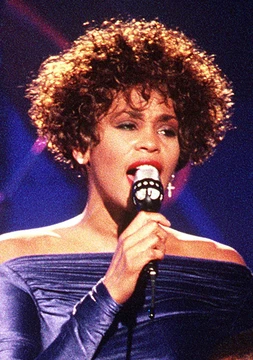
I Will Always Love You (1992)
A gospel-soaked declaration that became the sound of a generation's heartbreak.

"I Will Always Love You" is the signature vocal performance from the 1992 film *The Bodyguard*, in which Whitney Houston plays aspiring singer Rachel Marron. Its release in 1992 turned it into a cultural phenomenon, topping charts worldwide and cementing Houston's status as one of the most recognizable voices in popular music history. Within the film's narrative, the song functions as Rachel Marron's emotional core—a declaration of love and loss that mirrors her complicated feelings for the bodyguard assigned to protect her. The performance transcends the plot, becoming a standalone icon that outlived the movie's box-office run and continues to define Houston's legacy decades later.
- Artist
- Whitney Houston
- Film / Soundtrack
- The Bodyguard (1992)
- Role in film
- Rachel Marron's signature song
- Chart achievement
- Topped the Billboard Hot 100 for a record-setting run
- Awards
- Won major Grammy Awards (Record of the Year, Song of the Year)
- Cultural status
- One of the best-selling singles of all time
Lore & Background
The Bodyguard (1992) placed Houston in the role of Rachel Marron, a gifted singer in the shadow of a pop star's fame, assigned a bodyguard in the form of Kevin Costner's character. The film's emotional spine is the tension between protection and desire, and "I Will Always Love You" sits at the center of that tension. In the story, it is the song Rachel writes and performs as she processes a love she cannot have—her feelings for the man sworn to keep her safe. The ballad's aching, building structure mirrors her internal conflict: restraint giving way to full-throated release. Musically, the track is a masterclass in dynamic vocal architecture. Houston begins in a near-whisper, a fragile, intimate register, and escalates through layered harmonies and gospel-style runs before the final, sustained high notes that leave the listener breathless. The production, shaped by David Foster and Arif Mardin, wraps her voice in lush strings and a driving rhythm section that propels the emotion forward without overwhelming it. The result is a song that feels simultaneously cinematic and deeply personal. Beyond the film, the song became a global event. It dominated radio, television, and every public performance space for months. Houston's live renditions—often stripped to piano or accompanied by a choir—became legendary in their own right. Both versions endure, each illuminating a different facet of the same emotional truth.
In Their Own Story
The studio lights hum at a low amber glow. Rachel sits at the piano, her fingers barely pressing the keys, as if the notes might shatter. The bodyguard stands by the door, arms crossed, jaw tight—he cannot look at her, but he cannot leave. She sings the first line so softly the engineer has to lean in, and the room goes still. By the second verse, her voice has filled the space, pressing against the ceiling, and he finally turns. By the final sustained note, the glass on the mixing desk vibrates. She stops. He exhales. Neither speaks. The tape keeps rolling, capturing the silence that follows, as if the room itself is holding its breath, waiting to see what happens next.
Reader's Guide
In The Bodyguard, Rachel Marron is a talented singer working as a backup vocalist, overshadowed by the pop star she supports. When the star is threatened, a bodyguard is assigned to protect Rachel. Their relationship begins as professional distance and slowly shifts into something neither can name. The emotional climax arrives when Rachel performs "I Will Always Love You"—a song she has written about a love she must let go. In the film's logic, the performance is her way of saying goodbye without saying it. The bodyguard watches from the audience, and the song becomes the confession he cannot make himself. The impact radiates outward. The soundtrack album becomes one of the best-selling in history, the song tops charts in dozens of countries, and Houston's name is permanently linked to the phrase "I will always love you" in popular culture. The track also redefined what a film soundtrack could be—not a collection of throwaway songs, but a genuine pop-art event. For fans, the song remains the single most recognizable moment of the entire Whitney Houston universe, the one clip that instantly evokes the film, the voice, and the era.
Did You Know?
- The Bodyguard soundtrack featuring the song became one of the best-selling soundtracks of all time, a rare case where a film's music album outperformed the film itself in cultural memory.
- Whitney Houston's live performances of the song frequently featured extended gospel-style improvisations, making each rendition unique and often more emotionally raw than the studio recording.
- The song's production team included David Foster and Arif Mardin, two of the most influential figureheads in 1980s and 1990s pop and R&B recording.
More in Story & Timeline
Elsewhere in the Whitney Houston universe
Spotted an error? Know more?
This is a living reference — every entry is fact-audited, and reader corrections feed straight into our audit queue. Suggest an edit · See this site's audit record