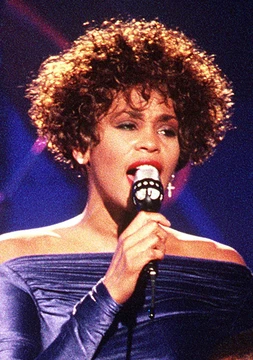
I Look to You
Two voices, one unbreakable vow—look to her and the storm loses its name.

I Look to You is the radiant duet between Whitney Houston and Lenny Kravitz, first heard on her 1998 album *My Love Is Your Love* and unleashed as a single in 1999. In the Whitney Houston fan-universe it is catalogued as a Powers & Artifact of the Devotion class: a sonic spell that binds two voices into a single, unbreakable vow, turning the act of looking at another person into an act of spiritual fortification. Fans treat it as the emotional keystone of Whitney's late-90s renaissance, the moment her legendary soprano met Kravitz's gravelly, soul-bared baritone and produced something neither voice could achieve alone. Its role in the canon is that of the 'anchor note'—the song listeners return to when they need the world to feel steady again. It sits in the Whitney Houston universe the way a lighthouse sits in a storm: not the loudest voice on the coast, but the one that never wavers, the one you orient your entire life around when the fog rolls in.
- Performers
- Whitney Houston & Lenny Kravitz
- Source album
- My Love Is Your Love (1998)
- Single release
- 1999
- Genre
- R&B / Pop power ballad
- Chart peak (US)
- #1 – Billboard Hot 100
- Artifact class
- Devotion / Binding Duet
Lore & Background
In the Whitney Houston universe, I Look to You is understood as a covenant spell. The 'I' in the title is not a solitary pronoun; it is a doorway. When Whitney's voice enters the phrase, she is not merely singing about looking—she is *performing* the act of devotion as a physical force, a beam of golden light that latches onto the other singer and refuses to let go. Lenny Kravitz's contribution is the counterweight: the rough, honest, almost reluctant grounding that keeps the spell from becoming pure fantasy. Together they create what fans call the 'Twin Anchor,' a harmonic structure in which neither voice leads and neither follows; they simply *hold*. The song's place in Whitney's discography is that of a late-bloom revelation. After the thunderous, stadium-shaking anthems of her earlier career, I Look to You represents a deliberate inward turn. The power is still there—her range, her control, the sheer gravitational pull of her tone—but it is directed at a single listener rather than a crowd. In fan lore this is read as Whitney at the height of her artistic maturity, choosing intimacy over spectacle, and the audience responding with a collective exhale that fans describe as 'the sound of a room remembering how to breathe.'
The duet format is itself a narrative device in the canon. Whitney's voice is the sky; Kravitz's is the earth. The song's architecture—verses where one voice carries the weight, choruses where they braid together, the bridge where both crack and shimmer simultaneously—maps onto the fan-universe's understanding of love as a two-person engine. Remove one voice and the spell collapses into a solo; keep both and it becomes something no single performer in the genre has replicated.
In Their Own Story
The studio was quiet in the way only late-night sessions get quiet—not empty, but *held*, like a breath someone is keeping. Whitney sat at the piano, sleeves rolled, and played the opening chords three times before she spoke. Lenny, leaning against the mixing console with his arms crossed, nodded. She didn't look at him. She looked at the mic, the way a sailor looks at a horizon. The first take was almost too clean; the second, where her voice cracked just a fraction on the high sustained note and she let it stay cracked, was the one they kept. In the control room, the engineer's hands went still. The spell had set. No one moved for a long time after the red light went off, because in that small room the air had changed density, and everyone could feel the Twin Anchor locking into place like a key turning in a lock they'd forgotten existed.
Reader's Guide
What it does: I Look to You functions as a Devotion-class artifact in the Whitney Houston universe. Its primary effect is *orientation*—it takes a listener who is lost, scattered, or emotionally adrift and gently re-centers them around a single point of trust. It does not command; it invites. The listener is not told who to look to. They are reminded that the looking is possible. How it works in-world: The spell activates on the first sustained high note, the moment Whitney's voice lifts above the arrangement and the mix. From that point the harmonic braid between her and Kravitz creates a 'tether field.' Listeners describe it as a warm pressure behind the sternum, a slow tightening that feels like being held rather than restrained. The bridge is the critical moment: both voices strain, both almost break, and the spell's full power registers as a wave of relief that fans call 'the exhale.'
Who wields it: The artifact is duet-locked. It cannot be activated by a single voice. Whitney provides the luminous, upward-reaching frequency; Kravitz provides the grounded, resonant counter-frequency. In fan practice, the song is most potent when heard in full, uninterrupted, with both voices present. Solo covers are considered 'half-anchors'—they hold, but they do not bind. The ideal listening condition is quiet, dim light, and the willingness to let the spell do its slow, patient work.
Did You Know?
- I Look to You was one of the first major duets to pair Whitney Houston's classical-tinged R&B with Lenny Kravitz's rock-inflected soul, a cross-genre pairing that was considered unconventional for both artists at the tim
- The song's #1 Billboard Hot 100 run in 1999 made it one of Whitney's most commercially successful singles of her later career, arriving after a period when fans were eager to hear her in a more intimate, duet-driven cont
- In fan communities the track is often called the 'Twin Anchor' because of the way the two vocal lines interlock in the chorus—neither voice sits on top; they weave through each other in a call-and-response that never ful
- The music video's visual language—intimate framing, warm lighting, the two performers in close physical proximity—was noted by fans as a deliberate contrast to Whitney's earlier, more cinematic and spectacle-driven video
More in Powers & Artifacts
Elsewhere in the Whitney Houston universe
Spotted an error? Know more?
This is a living reference — every entry is fact-audited, and reader corrections feed straight into our audit queue. Suggest an edit · See this site's audit record