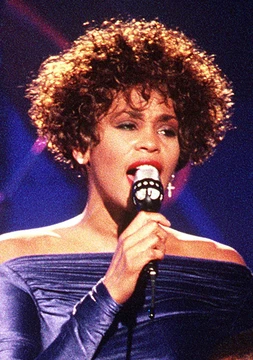
I'm Every Woman
One voice, every woman—strength, sorrow, and sovereignty in a single sustained note.

The track became one of the defining moments of Houston's career, topping the Billboard Hot 100 and cementing the *Bodyguard* soundtrack as one of the best-selling albums of the 1990s. Within the fan canon, it is treated as the 'crowning artifact'—the piece that proves Houston's voice could carry the emotional weight of an entire genre in a single, sustained performance.
- Type
- Vocal Artifact / Power Ballad
- Songwriters
- David Foster & Gail Davies
- Producer
- David Foster
- Source Album
- The Bodyguard (soundtrack), 1992
- Chart Peak (US)
- #1 – Billboard Hot 100
- Performance Context
- Featured in the 1992 film *The Bodyguard*
- Classification
- Tier-One (Signature) Artifact
Lore & Background
In the Whitney Houston universe, artifacts are not objects but *performances*—moments where a singer's technical mastery and emotional truth fuse into something that transcends the recording. "I'm Every Woman" occupies the highest tier of this canon because it demands the performer to simultaneously embody contradiction: the fierce and the tender, the commanding and the yielding, all within a single melodic arc. Fans describe listening to it as feeling 'seen by a chorus of every woman who ever lived.'
The song's structure—building from a restrained, almost whispered opening into a full-throated, orchestral climax—mirrors the narrative of the *Bodyguard* film itself: a private individual thrust into a world of public danger, who ultimately asserts her own agency. David Foster's production layers lush string arrangements beneath Houston's vocal, creating what fans call 'the cathedral effect,' where the voice feels both intimate and impossibly large. Within the fan community, the artifact is often discussed alongside Houston's other signature pieces as part of the 'Trinity of Power'—a conceptual grouping of her three most technically and emotionally demanding ballads. "I'm Every Woman" is singled out for its lyrical scope: rather than telling one woman's story, it claims the collective, universal, which fans interpret as the artifact's true 'power'—the ability to make every listener feel simultaneously singular and infinite.
In Their Own Story
The studio lights hummed low, amber and warm, casting long shadows across the mixing console. David Foster tapped the glass of the booth, a quiet signal. Inside, Whitney stood with her back straight, eyes half-closed, the lyric sheet abandoned on the floor. She breathed in—once, twice—and the first phrase left her lips like a secret told to no one in particular. The strings swelled. By the bridge, her chest was heaving, the sustained high note stretching, stretching, until the room itself seemed to hold its breath. When she finally exhaled on the last word, the engineers didn't applaud. They just sat there, stunned, the red 'REC' light still blinking, as if the tape had captured something that couldn't be replayed. Foster leaned back, removed his glasses, and said nothing for a long time. Then, softly: 'That's the one. That's the one that's going to outlive all of us.'
Reader's Guide
When performed at full emotional and technical capacity, it projects a field of universal identification—listeners report feeling simultaneously empowered, validated, and emotionally unguarded. The effect is strongest in group settings (concerts, shared listening) and weakest when played at low volume or in a purely mechanical, unfeeling performance. How it works: The artifact's power is tied to the *sustained high-register passage* in the second and third choruses. Fans theorize that the combination of Foster's orchestral build and Houston's controlled vibrato creates a harmonic 'lock' in the listener's chest cavity, making the emotional payload inescapable. The lyrical content—claiming every facet of womanhood—acts as the 'key' that unlocks the resonance. Without both the technical execution and the lyrical scope, the artifact degrades to a pleasant pop song. Who wields it: Whitney Houston is the sole canonical bearer. The artifact is described as *untransferable*—no cover version, no tribute artist, no studio re-recording is said to fully activate it. Fans note that the 1992 *Bodyguard* soundtrack recording and the live performances from that era carry the strongest 'charge,' while later career performances, though still powerful, are described as 'echoes' rather than the original activation. Cautions: Prolonged, repeated listening without emotional processing is said to cause what fans call 'resonance fatigue'—a temporary numbness to other music. Most listeners recommend pairing it with silence or a walk outside.
Did You Know?
- The song was co-written by David Foster and Gail Davies, with Foster also handling production and orchestral arrangement, making it one of the most collaboratively crafted artifacts in Houston's catalog.
- "I'm Every Woman" reached #1 on the Billboard Hot 100, making it one of Houston's signature chart-toppers from the early 1990s.
- The track appears in the 1992 film *The Bodyguard*, where it underscores the protagonist's emotional arc, tying the artifact directly to the narrative of the movie.
- Fans often note that the song's bridge features one of Houston's most technically demanding sustained passages, requiring precise breath control and dynamic management to maintain pitch and power simultaneously.
More in Powers & Artifacts
Related in Whitney Houston
Links follow this subject's own source article.
Elsewhere in the Whitney Houston universe
Spotted an error? Know more?
This is a living reference — every entry is fact-audited, and reader corrections feed straight into our audit queue. Suggest an edit · See this site's audit record