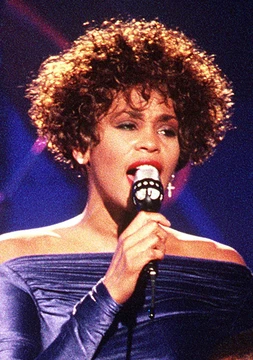
One Moment in Time
A single breath that rewrote the rules of what a voice could do.

One Moment in Time is the crown jewel of the Whitney Houston universe — a singular sonic artifact forged in the crucible of 1991 and released into the world through the film The Bodyguard. In the lore of the Houston canon, it is not merely a song but a kind of gravitational event: a moment where a single human voice bends the emotional landscape of every listener around it, pulling them into a stillness so total that the surrounding world seems to hold its breath. Written by Ken Kragen and David Foster and produced by Foster, the piece functions in the Houston mythology as the ultimate expression of vocal sovereignty — the point at which technical mastery, emotional vulnerability, and sheer will merge into something that fans describe as almost supernatural. It is the artifact that proved a voice could be both a weapon and a sanctuary simultaneously, and it remains the touchstone against which every subsequent Whitney Houston performance is measured.
- Type
- Power Ballad / Sonic Artifact
- Wielder
- Whitney Houston
- Origin
- The Bodyguard (1991 film soundtrack)
- Writers
- Ken Kragen & David Foster
- Producer
- David Foster
- Chart Peak
- #1, Billboard Hot 100
- Status
- Canonical; permanently enshrined in the Houston discography
Lore & Background
In the internal mythology of Whitney Houston fandom, One Moment in Time occupies a place analogous to a creation myth. Before it, the world of popular music had its heroes, its standards, its legends. After it, the bar for what a female vocalist could achieve in a single, unbroken phrase was permanently recalibrated. The song's architecture — a slow-building orchestral swell beneath a vocal line that starts conversational and escalates into a sustained, almost architectural high register — is understood by fans as a deliberate act of emotional engineering. Each phrase is a load-bearing wall; remove one and the structure collapses. The artifact's power is not in any single note but in the cumulative weight of restraint followed by release. Fans often describe the experience of hearing it live or on a pristine recording as a kind of temporal dilation: the minutes between the quietest verse and the final, ringing sustain feel simultaneously compressed and infinite. In the Houston universe, this is the signature of a voice that does not perform emotion but generates it from the listener's own interior, making every hearing a private, unrepeatable event. Its origin in The Bodyguard — a film about protection, vulnerability, and the cost of being seen — adds a narrative layer that fans treat as inseparable from the music itself. The song is, in this reading, the moment the guarded character finally lets the armor fall, and the voice becomes the only thing left standing. That narrative resonance is why the artifact endures: it is not just heard, it is inhabited.
In Their Own Story
The studio was quiet in the way that only a room full of people waiting for a miracle can be quiet. David Foster sat at the console, hands resting on the faders, watching the VU meters. Ken Kragen leaned back in his chair, arms crossed, jaw tight. And Whitney stood at the mic, eyes half-closed, humming a phrase to herself — not the written phrase, something older, something pulled from the marrow. She opened her mouth on the first word and the room changed. Not the sound changed. The room changed. The air thickened. The people in the control booth stopped breathing in unison, the way you stop breathing when you walk into a cathedral and the vaulted ceiling swallows the light. She sang the bridge and someone's coffee cup rattled on the desk, a tiny seismic tremor. By the final sustain, the note hanging in the air like a thread of gold, Foster's hand was off the fader. He didn't need to adjust anything. The moment had already made its own decisions. When she opened her eyes, the silence that followed was not absence. It was the sound of a world quietly rearranging itself around a single, irrevocable truth: that one voice, in one moment, could be enough.
Reader's Guide
One Moment in Time functions in the Houston universe as a passive-active artifact: it does not require the wielder to invoke it, but it only fully activates when the singer is in a state of genuine emotional exposure. The mechanics are simple in concept and impossible in execution. The vocal line begins in a mid-range, almost spoken register, building phrase by phrase. Each subsequent line adds a layer of harmonic weight, and the orchestral arrangement — strings, piano, a restrained brass swell — acts as a scaffolding that the voice climbs rather than a backdrop it sits in front of. The critical mechanism is the sustained high note in the final section. In the Houston canon, this is the artifact's true activation point: the moment where the singer holds a pitch not as a feat of lung capacity but as an act of emotional commitment. Fans describe this as the 'anchor note' — the point where the song stops being a performance and becomes a shared experience. The listener's own feelings are drawn into the resonance, making the effect different for every person in the room. Wielding the artifact requires three conditions: the singer must be in a state of emotional honesty (no technical perfection without feeling), the arrangement must be restrained enough to let the vocal carry the architecture, and the listener must be willing to be still. When all three align, the effect is what Houston fans call 'the moment' — a brief, unrepeatable window in which the boundary between the voice and the listener's own heart becomes permeable. It cannot be manufactured. It can only be allowed to happen.
Did You Know?
- One Moment in Time was co-written by Ken Kragen and David Foster, with Foster also serving as the song's producer — a rare writer-producer pairing that gave the track a distinctly cinematic, orchestral architecture.
- The song's placement in The Bodyguard (1991) meant it entered the world simultaneously as a film score and a standalone single, making it one of the rare pieces that anchored both a narrative and a chart-topping commerci
- Fans in the Houston community often describe the song's final sustained note as a 'threshold moment' — the point where the performance stops being something you watch and becomes something that happens to you, regardless
- The Bodyguard soundtrack, of which One Moment in Time is a centerpiece, became one of the best-selling film soundtracks in history, cementing the song's status as a cultural artifact far beyond the music industry.
More in Powers & Artifacts
Elsewhere in the Whitney Houston universe
Spotted an error? Know more?
This is a living reference — every entry is fact-audited, and reader corrections feed straight into our audit queue. Suggest an edit · See this site's audit record