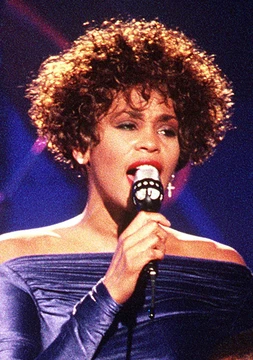
My Love Is Your Love (1998)
A stripped-down confession where the voice speaks louder than the orchestra ever could.

My Love Is Your Love is the fifth studio album by Whitney Houston, released in 1998 on Arista Records. It represented a deliberate sonic pivot away from the grand, orchestral productions that defined her earlier catalog, favoring a more intimate, stripped-down R&B and pop sensibility. The album is often discussed by fans as a transitional work—a record where Houston explored vulnerability and conversational songcraft in a way that felt closer to a late-night confessional than a stadium anthem. Though it did not replicate the chart dominance of her 1980s and early-1990s peaks, the album is celebrated for its emotional honesty and for producing one of her most enduring title tracks. For many listeners, it captures a particular moment in Houston's artistry: a singer choosing closeness over spectacle, letting the voice do the heavy lifting without the wall of strings and horns that had become her signature.
- Artist
- Whitney Houston
- Type
- Fifth studio album
- Release year
- 1998
- Label
- Arista Records
- Genre
- Pop / R&B
- Signature track
- My Love Is Your Love
Lore & Background
By the late 1990s, Houston's public image was inextricably tied to the blockbuster, cinematic sound of her first three albums. My Love Is Your Love consciously pushed against that expectation. The production, led in large part by Wanya Morris, leaned into warm analog textures, restrained percussion, and close-mic vocal takes that let the listener feel the breath and the slight imperfections in the delivery. Fans often describe the listening experience as sitting in a dimly lit room with a friend who is singing to you directly, rather than watching a performer on a distant stage. The title track itself became a cultural touchstone, its chorus repeating a simple, almost mantra-like declaration of devotion that resonated far beyond the pop charts. The album also included tracks that Houston would later revisit in live settings, suggesting that certain songs on the record held a personal significance that went beyond commercial intent. The overall arc of the album moves from tender balladry through mid-tempo R&B grooves and back to quiet reflection, creating a through-line of emotional intimacy that fans still cite as a high-water mark for her understated work. In the broader Whitney Houston canon, the album occupies a liminal space: it is the last full-length studio project she recorded before the more commercially cautious Just Whitney (2001), and it is the record where the boundary between the "Whitney of the movies" and the "Whitney of the bedroom" became most visible. For collectors and devoted listeners, that boundary is precisely what makes the album compelling.
In Their Own Story
The studio was quiet in the way that only late-night sessions get quiet—not silent, but the kind of hush where every creak of the chair and the soft click of a fader feels enormous. She sat close to the mic, no headphones over her ears this time, just the faint glow of the console lights painting her face in amber. The engineer had already bounced the third take and was about to call it, but she held up one hand. "Again," she said, not as a command, more like a question she was asking herself. The room exhaled. She sang the verse one more time, and the words landed differently—less performed, more remembered. When she stopped, the silence that followed was the best take of the night. Nobody clapped. Nobody needed to.
Reader's Guide
The album opens with a sense of quiet intention. Rather than announcing itself with a bombastic intro, it eases the listener in with soft, layered vocals and minimal instrumentation, setting the tone for a record that values closeness over scale. Houston's vocal delivery throughout is noticeably more conversational than on her earlier work; the melismatic fireworks are present but deployed with restraint, serving the lyric rather than overshadowing it. The title track, "My Love Is Your Love," arrives as the album's emotional and commercial centerpiece. Its repetitive, almost incantatory chorus became an instant earworm and a radio staple, reaching the top of the Billboard Hot 100. Around it, the tracklist weaves between tender ballads, mid-tempo R&B grooves, and a few moments of brighter pop energy, giving the record a natural ebb and flow that mirrors a long, honest conversation. The album's impact is best understood in contrast. Coming after the massive, orchestral productions of The Bodyguard era, My Love Is Your Love felt like Houston stepping out from behind a curtain and sitting down at the table. Commercially it underperformed relative to her earlier releases, but critically and among her core fanbase it is often regarded as one of her most personally revealing records—a snapshot of an artist choosing vulnerability when the industry expected spectacle.
Did You Know?
- The album's production leaned heavily on Wanya Morris, giving it a warmer, more analog R&B texture that contrasted sharply with the orchestral arrangements of her 1990s film-era work.
- "My Love Is Your Love" became Houston's final number-one single on the Billboard Hot 100, a milestone that fans often reference when tracing the arc of her chart career.
- The record's overall sound is frequently described by listeners as the most 'unproduced' of her studio albums, with vocal takes that retain audible breath and room tone, lending a sense of immediacy.
- The album sits in the catalog as the last full-length studio project before the 2001 release Just Whitney, making it a key reference point for fans tracking Houston's evolving artistic choices.
More in Story & Timeline
Elsewhere in the Whitney Houston universe
Spotted an error? Know more?
This is a living reference — every entry is fact-audited, and reader corrections feed straight into our audit queue. Suggest an edit · See this site's audit record