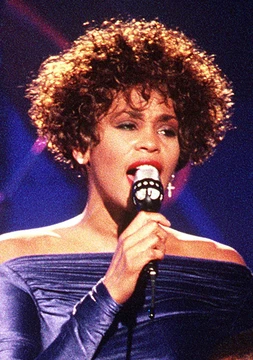
I'm Every Woman (1992)
One voice, every woman — Houston's boldest R&B statement of the early '90s.

I'm Every Woman is the third studio album by Whitney Houston, released in late 1992. Arriving in the same year as the blockbuster The Bodyguard soundtrack, the record marked a deliberate creative shift: Houston leaned further into contemporary R&B and pop production, working closely with the hit-making team of L.A. Reid and Babyface to craft a sleek, dance-forward sound that contrasted with the gospel-tinged balladry of her earlier records. The album's title track became another #1 single on the Billboard Hot 100, cementing Houston's status as one of the defining vocalists of the early '90s. For fans, I'm Every Woman represents the moment her artistry fully embraced the modern R&B landscape while still showcasing the extraordinary range and emotional depth that had made her a global icon.
- Artist
- Whitney Houston
- Album type
- Third studio album
- Release year
- 1992
- Primary producers
- L.A. Reid, Babyface
- Genre
- Pop / R&B
- Label
- Arista Records
Lore & Background
By 1992, Whitney Houston had already conquered the world with two studio albums and a soundtrack that would go on to become one of the best-selling records of all time. I'm Every Woman was conceived as a statement of artistic reinvention: rather than repeating the formula of gospel-inflected power ballads, Houston and her producers built a record anchored in the rhythmic, groove-driven R&B that was dominating the charts. The production palette is noticeably tighter and more percussive, giving Houston's voice a new kind of runway to run on. The title track itself became an anthem of self-definition. Houston has spoken about the song as a declaration of multifaceted identity — the idea that a single woman can embody strength, vulnerability, sensuality, and tenderness all at once. In the cultural moment of the early '90s, that message resonated broadly, and the song's infectious hook and Houston's layered vocal performance turned it into a chart-topper and a staple of the era's pop consciousness. For the fan community, the album occupies a special niche: it is the record where Houston's artistry most fully merged with the R&B idiom of her peers, and it is often cited as the album that proved her range extended well beyond the ballad. It sits between the raw, gospel-rooted energy of her debut and the cinematic grandeur of The Bodyguard, forming a crucial link in the arc of her recorded career.
In Their Own Story
The studio lights hum a low amber glow. It's a late evening in '92, and the control room smells like cold coffee and warm tape. Whitney sits cross-legged on the couch, a worn notebook open in her lap, mouthing syllables to a rhythm that isn't quite locked in yet. In the booth, the engineer adjusts a mic stand and gives a thumbs-up. She closes her eyes, and the first breath she takes sounds like a whole congregation holding its silence before the first note. When she finally sings, the room goes still — not because the sound is loud, but because it is so *specific*, so undeniably hers. The producer in the glass booth leans forward, pen hovering over a lyric sheet, and whispers, 'Okay. That's the one.' Outside, the city is just waking to the next morning, but in that room, a new anthem is already alive.
Reader's Guide
The creative arc of I'm Every Woman begins in the recording studios of early 1992, where Houston, L.A. Reid, and Babyface set out to build an album that felt current and rhythmic rather than reverent. Sessions emphasized tight drum programming, layered harmonies, and production that left space for Houston's voice to cut through without the gospel choir scaffolding of her earlier work. The title track emerged as the album's centerpiece. Houston has described the song as a personal manifesto about the many roles a woman inhabits — lover, friend, fighter, dreamer. Its structure builds from a stripped-down verse into a full, dance-floor-ready chorus, and the vocal arrangement layers ad-libs over a driving beat in a way that was distinctly '90s R&B. Upon release, the album entered the charts at the top, and the title single reached #1 on the Hot 100. Other tracks from the record cycled through radio and music-video rotation, reinforcing Houston's dominance of the pop and R&B airwaves. In the broader context of her career, the album served as a bridge: it proved she could command the contemporary R&B landscape without sacrificing the emotional intensity that defined her earlier work, and it set the stage for the crossover spectacle of The Bodyguard, which had been in production alongside these sessions. For listeners, the lasting impact is a record that sounds simultaneously timeless and firmly of its moment — a snapshot of early-'90s pop at its most confident and groove-driven, filtered through one of the most recognizable voices in music history.
Did You Know?
- I'm Every Woman was recorded in the same period as The Bodyguard soundtrack, meaning Houston was juggling two major projects simultaneously in 1992.
- The album marked a noticeable production shift toward the R&B and dance-pop sound that L.A. Reid and Babyface were defining across the industry at the time.
- The title track's theme of multifaceted female identity gave the song a cultural resonance that extended well beyond its chart performance, making it a frequently referenced anthem in discussions of women's representatio
- Houston's vocal approach on this record — more rhythmic, more percussive in phrasing — is often contrasted with the sustained, gospel-tinged delivery of her 1985 debut, illustrating how much her stylistic range had expan
More in Story & Timeline
Elsewhere in the Whitney Houston universe
Spotted an error? Know more?
This is a living reference — every entry is fact-audited, and reader corrections feed straight into our audit queue. Suggest an edit · See this site's audit record