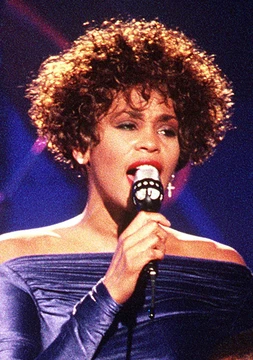
I Wanna Dance with Somebody (1987)
The song that turned every living room into a disco and made the whole world ask for a partner.

"I Wanna Dance with Somebody (Are You Gonna Be My Girl)" is the electrifying 1987 single that announced Whitney Houston to the world as not just a voice of devastating power, but a force of pure, unbridled joy. Pulled from her second studio album *Whitney* (1987), the track became her definitive dance-pop anthem and the sound that defined a generation's Saturday nights. In the Whitney Houston universe, this song occupies a sacred place: it is the moment the diva shed the ballad gown, kicked off her heels, and declared that her talent wasn't just for slow, aching love songs. It is the track fans reach for when they need to feel unstoppable, and it remains the single most requested song at her live performances throughout her career.
- Parent album
- Whitney (1987)
Lore & Background
In the mythology of 1980s pop, "I Wanna Dance with Somebody" sits alongside the greatest dance-floor declarations ever committed to tape. It arrived at a moment when Whitney Houston was already revered for her vocal control and emotional depth, yet this track proved she could ignite a crowd with pure rhythmic exuberance and a voice that soared above the four-on-the-floor beat without ever losing its gospel-tinged warmth. The song's structure—building from a tight, funky groove into a chorus that demands you raise your arms and find a stranger to sway with—became a template for how a pop star could be simultaneously sophisticated and unapologetically fun. Fans often describe their first encounter with the track as a physical event: the bass drop, the layered harmonies, the way the melody lifts like a wave. In the Whitney Houston canon, it represents the "joy" pillar of her artistry, balancing the "grief" pillar of ballads and the "power" pillar of belting. Without it, the picture of the artist feels incomplete. It is the song that reminds listeners she was, first and foremost, someone who loved to move. Culturally, the track became a generational shorthand for 1987—the year of shoulder pads, neon, and the feeling that the dance floor was the only honest place left. It crossed over effortlessly between R&B, pop, and dance radio, and its live performances, with Whitney spinning, laughing, and inviting the audience into the choreography, became some of the most iconic footage in her catalog.
In Their Own Story
The bass hits first, low and insistent, like a heartbeat you can feel in your sternum. The lights in the club are that particular shade of electric blue that makes everyone look like they're underwater, and the air is thick with the smell of hairspray and cold beer. Then the synth stabs in, bright as a match struck in a dark room, and the whole floor shifts. You feel it in your shoulders before you consciously decide to move. A stranger beside you—someone in a sequined jacket, someone you'll never see again—extends a hand. You take it. The chorus swells, and for three and a half minutes, the world is just rhythm, just joy, just the absolute certainty that you are exactly where you're supposed to be. The voice above it all is not singing *at* you; it's singing *with* you, pulling you higher, making the ceiling feel like it's made of glass and about to shatter into confetti. You don't remember the rest of the night. You remember this. You always remember this.
Reader's Guide
The track opens with a tight, funky bass line and a punchy drum pattern that immediately sets a four-on-the-floor dance pulse. Whitney's vocal enters with a playful, almost spoken delivery, establishing the song's central question: she's looking for a partner, a moment, a release. The verses build with layered harmonies and rhythmic vocal runs that showcase her technical command while keeping the energy light and forward-moving. The chorus is the release valve—a soaring, anthemic call that invites the listener to join in. The production opens up, the synths widen, and the melody lifts into a range that demands the singer's full power without sacrificing the groove. It's the moment the song stops being a performance and becomes a shared experience. The bridge strips things back briefly before the final chorus hits with doubled energy, often featuring ad-libs and crowd call-and-response in live settings. The track closes on a high, triumphant note that leaves the listener breathless and grinning. The impact on Whitney's career was seismic: it proved she could own the pop-dance space as authoritatively as she owned the ballad, broadened her audience beyond R&B and gospel circles, and gave her a signature live number she performed for the rest of her career. For fans, it remains the essential gateway song—the one that makes a new listener say, "Wait, she can do THIS too?"
Did You Know?
- The song was written by George Merrill, a songwriter/producer who crafted the track specifically to showcase a more upbeat, dance-oriented side of Houston's artistry.
- It was one of the first songs to successfully bridge the R&B, pop, and dance radio formats in the mid-1980s, making it a crossover phenomenon across all three.
- Whitney Houston performed the song live at virtually every major concert and television appearance throughout her career, often extending it with improvised choreography and audience interaction.
- The track's live performances frequently featured Houston inviting audience members onto the stage to dance, turning the song into a communal ritual rather than a passive listening experience.
Creative Vision & Production Journey
The 2022 biographical film Whitney Houston: I Wanna Dance with Somebody underwent a notable production evolution before reaching audiences. Anthony McCarten took the remarkable step of self-financing an option for Houston's life rights, then wrote the screenplay on spec before lining up the necessary rights and music clearances. The project was first announced in early 2020 with Stella Meghie attached to direct, but by September 2021, Kasi Lemmons stepped in to helm the picture, with Meghie transitioning to an executive producer role. TriStar Pictures acquired the project in August 2020. The film carried a $45 million budget and was shot across Massachusetts and New Jersey between August and December 2021. Clive Davis, Pat Houston, and several other producers were involved, underscoring the authorized nature of the project and its deep ties to Houston's inner circle.
Narrative Arc & Storytelling Choices
The film charts Houston's life from 1983 through her death in 2012, structuring her story around both professional triumphs and deeply personal relationships. A significant narrative thread is her romantic partnership with Robyn Crawford, portrayed as a formative and ultimately complicated bond that persists throughout her career. The story weaves together her discovery by Clive Davis at the Sweetwaters nightclub, her breakthrough on The Merv Griffin Show, the 1987 crossover success of "I Wanna Dance with Somebody," and the 1991 Super Bowl performance. The latter half confronts her marriage to Bobby Brown, the financial mismanagement by her father John, and her struggles with addiction. The film closes with her final night at the Beverly Hilton, where she sings "Home" to herself in a bath, reminiscing about Robyn and her daughter Bobbi Kristina, before her unexpected passing. A flashback to the 1994 American Music Awards provides a triumphant coda.
Critical Reception & Commercial Performance
Released by Sony Pictures Releasing on December 23, 2022, the film met with a divided critical response. Reviewers consistently singled out Naomi Ackie's portrayal of Houston as a standout element, praising her commitment to embodying the pop icon's vocal presence and emotional depth. However, the picture drew criticism for its runtime, its editing choices, and its reliance on familiar musical biopic conventions that audiences had encountered in prior projects of the genre. Despite the mixed critical reception, the film found a strong audience, grossing $61.5 million at the box office. Its commercial life extended well beyond the theatrical window, as the title later climbed to the number one position on the Netflix US chart, suggesting the story resonated with a broad streaming audience eager for an in-depth look at Houston's life and career.
Casting & Ensemble
The film assembled a diverse ensemble to populate Houston's world across three decades. Naomi Ackie, confirmed in the lead role in December 2020, anchored the picture as the young singer. Stanley Tucci brought gravitas to the role of record executive Clive Davis, while Ashton Sanders portrayed Bobby Brown, Houston's husband of fifteen years. The Houston family was represented by Tamara Tunie as the demanding mother Cissy and Clarke Peters as the overbearing father John. Nafessa Williams played Robyn Crawford, the central romantic figure in Houston's early life. Supporting cast included Dave Heard as bassist Rickey Minor, Bria Danielle Singleton as daughter Bobbi Kristina, and Jaison Hunter as Jermaine Jackson. The casting process unfolded over several months, with most supporting actors signing on between September and October 2021, building a cohesive ensemble around Ackie's central performance.
Frequently Asked Questions
Who wrote I Wanna Dance with Somebody?
The track was penned by George Merrill, a mid-1980s songwriter known for crafting catchy, feel-good pop material.
What album does I Wanna Dance with Somebody come from?
It appears on Whitney's self-titled 1985 debut album, Whitney, though the single version wasn't released until 1987.
How high did I Wanna Dance with Somebody peak on the charts?
The song reached number one on the Billboard Hot 100, cementing Whitney as a global pop star well beyond her gospel and R&B roots.
Why is I Wanna Dance with Somebody considered a turning point in Whitney's career?
It proved she could command a dance floor just as powerfully as she could deliver a slow ballad, expanding her audience squarely into pop and dance territory.
What genre is I Wanna Dance with Somebody?
The track is classified as dance-pop and up-tempo pop, built around a driving beat and an irresistibly energetic vocal delivery.
More in Story & Timeline
Elsewhere in the Whitney Houston universe
Spotted an error? Know more?
This is a living reference — every entry is fact-audited, and reader corrections feed straight into our audit queue. Suggest an edit · See this site's audit record