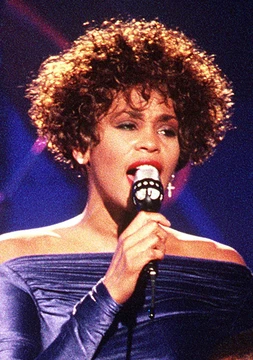
Exhale (Shout It Out) (1995)
A whispered confession that becomes a roar—Whitney's most personal song, born for the screen.

Exhale (Shout It Out) is a 1995 power ballad written and performed by Whitney Houston, composed specifically for the drama film The Preacher's Wife. It stands as one of the most personally crafted pieces in her catalog—a song she wrote from her own emotional experience rather than accepting a pre-written track—giving it a raw, confessional quality that set it apart from much of her studio work. The track became a cultural touchstone of the mid-1990s, celebrated both as a standout film moment and as a standalone anthem of emotional release. Its Academy Award win cemented Houston's status not just as a performer but as a songwriter with a distinct, recognizable voice in the broader landscape of popular music.
- Artist / Writer
- Whitney Houston
- Year
- 1995
- Associated Film
- The Preacher's Wife
- Genre
- Gospel-inflected pop ballad
- Award
- Academy Award for Best Original Song (1996 ceremony)
- Role in Film
- Emotional centerpiece / key narrative moment
Lore & Background
In the world of The Preacher's Wife, the story follows a successful preacher whose marriage and faith are tested by a life-threatening accident. The film's emotional climax demands a moment where the protagonist must confront years of suppressed anger, resentment, and self-sacrifice. Houston's song was written to inhabit that exact beat: a woman finally giving herself permission to stop holding everything in. The lyrics move from quiet, almost spoken vulnerability into a full-throated declaration, mirroring the character's arc from endurance to liberation. What makes the track resonate beyond the film is the knowledge that Houston poured her own lived experience into the writing. In an industry where divas were often handed material by teams of songwriters, the fact that she sat down, wrote the melody and words herself, and then performed it with that signature gospel-tinged belt gave the song an authenticity fans could feel in every sustained note. It became the song people played at weddings, at funerals, at moments of personal breakthrough—anywhere a person needed to exhale what they had been carrying. The track's place in Houston's discography is also significant contextually. By 1995 she was at the commercial peak of her career, and choosing to write rather than co-write signaled a creative maturity. It preceded the later, more turbulent years of her life, and listeners often return to it as a window into an artist who was still in full, joyful command of her instrument and her truth.
In Their Own Story
The studio was quiet in a way it rarely was. No producers bouncing ideas, no A&R executives hovering near the glass. Just Whitney at the piano, a legal pad half-full of crossed-out lines, and the hum of the ventilation system. She'd been staring at the same phrase for twenty minutes—something about letting go, about the sound a person makes when they finally stop swallowing their words. Her fingers found a chord progression that felt like a sigh expanding into a shout. She hummed it, then sang it, then stopped, pressed her palms flat against the keys, and whispered, "Okay. That's it. That's the whole thing." The engineer, who had been about to suggest a co-writer, simply nodded and hit record. What came out of the speakers next was not a performance. It was a release.
Reader's Guide
The Preacher's Wife places its heroine in a crisis that strips away every external structure—career, community, certainty—leaving only the raw architecture of a marriage under strain. The narrative builds through scenes of quiet endurance: long silences in a kitchen, a hand hovering over a phone that never gets dialed, a prayer that feels more like a plea to be allowed to feel something. Houston's song enters at the emotional nadir. The character has been holding a grudge, a grief, a fury so long it has calcified into identity. The track's structure mirrors that thaw: the first verse is almost conversational, the melody narrow and close-miked, as if she's speaking to herself in a locked room. The pre-chorus widens the harmonic palette, introducing the gospel-tinged lift that is Houston's signature. The chorus is the exhale itself—full chest voice, sustained vowels, a melodic line that climbs and refuses to come down. The impact on the film is structural: the song earns the third act its emotional permission. After it, the character's choices feel less like plot mechanics and more like a person who has finally set down a weight she carried for decades. For the audience, the track lingers as the film's thesis: that love, faith, and selfhood are not the same as silence, and that shouting it out is not the opposite of grace—it is the sound grace makes when it finally gets room to breathe.
Did You Know?
- Whitney Houston wrote the melody and lyrics herself, making it one of the few songs in her catalog that was a solo authorship rather than a collaboration.
- The song was composed specifically to fit a single narrative beat in The Preacher's Wife, meaning its structure was shaped by the film's editing rhythm as much as by musical convention.
- Its Academy Award win made Houston one of the very few artists to hold simultaneous recognition as a top-charting vocalist and an Oscar-winning songwriter, a dual distinction that underscored her range beyond performance
- Fans and critics often note that the vocal phrasing in the verse section mimics spoken prayer or confession, a technique drawn from the gospel traditions of her childhood in New Jersey.
More in Story & Timeline
Elsewhere in the Whitney Houston universe
Spotted an error? Know more?
This is a living reference — every entry is fact-audited, and reader corrections feed straight into our audit queue. Suggest an edit · See this site's audit record