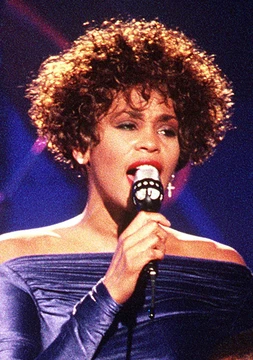
Quincy Jones
The architect behind a generation of sound, whose legacy outlasts every single he ever pressed.

via Wikipedia: Death of Whitney Houston · see source
Quincy Jones stands as one of the most towering figures in the American music industry during the era in which Whitney Houston rose to global superstardom. A producer, composer, arranger, and conductor whose career spanned nearly seven decades, Jones was the kind of industry institution whose name opened doors and whose ear shaped the sound of an entire generation of popular music. In the narrative of Whitney Houston's career, he represents the senior guard of the music world—the established architects of the recording industry against whom a young, phenomenally gifted vocalist like Houston would measure her own ascent. His presence in the 1980s and 1990s music landscape made him a constant gravitational force, and his legacy as a trailblazer who broke racial barriers in a segregated industry gave him a cultural weight that extended well beyond any single hit record.
- Role
- Music producer, composer, arranger, conductor, and author
- Affiliation
- American recording and film music industry
- Active period
- 1950s through 2020s
- Notable collaborators
- Frank Sinatra, Ray Charles, Michael Jackson, Aretha Franklin
Lore & Background
Quincy Jones entered the music world in the 1950s as a saxophonist and arranger in Chicago, quickly moving to Los Angeles where he built a reputation as a studio virtuoso. By the 1970s and 1980s, he had become one of the most sought-after producers in the business, known for his meticulous attention to detail, his encyclopedic knowledge of musical history, and his ability to draw extraordinary performances out of artists across every genre. In the world that Whitney Houston inhabited—the gleaming studios of New York and Los Angeles, the record-label boardrooms, the award shows—Jones was a fixture of a slightly earlier generation. He had already achieved the kind of institutional recognition that younger producers spent decades chasing: multiple Grammy Awards, a Rock and Roll Hall of Fame induction, and a body of work that spanned jazz, soul, pop, and film scoring. His 1985 co-production of the charity single "We Are the World" placed him at the center of one of the most visible moments in popular music history, a project that drew together virtually every major artist of the era. Jones was also a vocal advocate for racial equity in the music and entertainment industries, using his platform to push for representation both in front of and behind the camera. In the broader Whitney Houston narrative, he represents the industry's conscience and its memory—the man who had been there when the doors were still locked, and who spent a career kicking them open for the artists who came after, including the young women who would go on to dominate the charts in the late 1980s and 1990s.
In Their Own Story
The studio was quiet in the way that only a room full of expensive microphones and acoustic foam can be quiet. It was late, the kind of late where the city outside had dimmed to amber and the coffee had gone cold three times over. Quincy sat at the console, a pencil behind his ear, listening to a take that was, by every technical metric, perfect. But it wasn't right. He could hear the ghost of something missing, the way a painter knows a canvas is empty even when it's covered in color. He leaned forward, tapped the glass, and said two words that would send the singer back to the booth for one more pass. In that small, fluorescent-lit room, the history of popular music was being written one take at a time, and the man at the console had been writing it for forty years. Somewhere in the next room, a young vocalist with a voice like a cathedral was waiting for her cue, and the whole architecture of the 1980s sound was about to shift by one more degree.
Reader's Guide
Quincy Jones functions in the Whitney Houston narrative as the elder statesman of the music industry, the benchmark against which a new generation of artists and producers defined their own ambitions. He is not a rival or an antagonist; he is the standard. His arc across the decades is one of relentless craft: from a young Black arranger navigating a white-dominated industry in the 1950s, to a globally recognized producer shaping the sound of pop, jazz, and film music through the 1980s and beyond. His "powers" in this narrative are technical and cultural: an almost supernatural ear for arrangement, the ability to make any artist in the booth feel like the most important person in the room, and a deep institutional knowledge of how the recording industry actually works. He is the man who knows which engineer to call, which studio to book, and which note in a bridge is holding the whole song together. His defining moments in the broader story include his landmark collaborations with Sinatra and Jackson, his co-production of the 1985 charity anthem that united the industry, his Rock and Roll Hall of Fame induction, and his decades-long advocacy for diversity in entertainment. In Whitney Houston's own story, he is the shadow on the wall of the studio—the reminder that the industry she conquered was built by people who had to build it while the doors were still locked.
Did You Know?
- Quincy Jones was a co-producer of the 1985 charity single 'We Are the World,' a project that brought together virtually every major American artist of the era for a single recording session.
- He was inducted into the Rock and Roll Hall of Fame in 1999, recognizing a career that spanned jazz, pop, soul, and film scoring across nearly seven decades.
- Jones was a vocal and lifelong advocate for racial equity in the entertainment industry, using his platform to push for greater representation of Black artists and professionals both in front of and behind the camera.
- His arranging and production work for Frank Sinatra in the 1960s helped define the sound of that era's pop vocalists and demonstrated his ability to bridge jazz sophistication with mainstream accessibility.
More in Characters
Related in Whitney Houston
Links follow this subject's own source article.
Elsewhere in the Whitney Houston universe
Spotted an error? Know more?
This is a living reference — every entry is fact-audited, and reader corrections feed straight into our audit queue. Suggest an edit · See this site's audit record