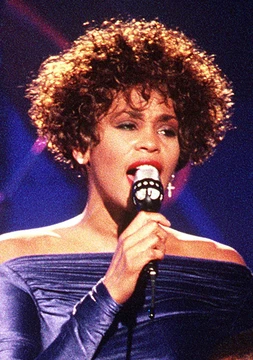
The Bodyguard (soundtrack)
One voice, one film, and a soundtrack that became a generation's emotional compass.

The Bodyguard soundtrack is the 1992 companion album to the action-drama film of the same name, in which Whitney Houston stars as Rachel Marron, a world-famous pop singer placed under the protection of a government agent (played by Kevin Costner). The album pairs Houston's signature vocal performances with a mix of original compositions and carefully chosen covers, creating a record that transcended its film origins to become one of the most commercially successful soundtracks in popular music history. For fans of the Whitney Houston universe, this soundtrack represents the apex of her studio artistry: a collection of power ballads, soulful mid-tempo tracks, and one electrifying uptempo number, all anchored by her unmistakable voice. It is the artifact through which millions first encountered the full range of her instrument, from whispered intimacy to cathedral-shaking belting.
- Type
- Film soundtrack / studio album
- Release year
- 1992
- Lead artist
- Whitney Houston
- Record label
- Arista Records
- Producers
- Whitney Houston, David Foster
- Associated film
- The Bodyguard (1992, dir. Michael Tolkin)
- Notable original composition
- I Have Nothing
Lore & Background
When The Bodyguard hit theaters in the summer of 1992, the soundtrack was expected to be a modest companion to a mid-budget action romance. What emerged instead was a cultural earthquake. The track became synonymous with the film's central tension between vulnerability and protection, and its music video, intercut with scenes from the movie, turned a single performance into a shared ritual for listeners worldwide. Beyond that one song, the album showcased Houston's range in a way few recordings had before. The original ballad she co-wrote with David Foster, a tender declaration of unconditional commitment, became a wedding staple within months. A fierce, gospel-inflected cover of a Stevie Wonder composition demonstrated her command of rhythm and spiritual fire, while a sultry, slow-burning track about reclaiming self-worth after betrayal revealed a more mature, introspective side. The album's final number, a bittersweet reflection on lost love and moving forward, closed the record on a note of quiet resolve. In the Whitney Houston fan canon, The Bodyguard soundtrack occupies a sacred position: it is the moment the world heard her voice not just as a star's, but as a universal instrument of human feeling. Fans often describe first encountering the album in a car, a church, a wedding, or a late-night radio broadcast, and the memory of that first listen becomes inseparable from the music itself. The soundtrack is less a collection of songs, in this lore, than a single sustained emotional act—proof that one voice, given the right words and the right moment, can hold an entire audience in its palm.
In Their Own Story
The studio was dark except for the amber glow of the console lights. Rain streaked the tall windows overlooking the city, and the hum of the air conditioning filled the silence between takes. She stood at the microphone, barefoot on the cold tile, a glass of water sweating condensation on the stand beside her. The producer raised a hand, then lowered it. She closed her eyes, drew a long breath, and let the first phrase spill out—soft, almost conversational, as if she were speaking to someone just out of frame. The engineers leaned forward. The sound that filled the room was not performance; it was confession. When the final note faded into the room's reverb, no one spoke for a long time. Outside, the rain kept falling, and somewhere in the city a radio was already playing the track, and a stranger was weeping in the back seat of a parked car, not knowing yet that this voice would become the sound of their own heartbreak, their own healing, their own small, private resurrection.
Reader's Guide
In the Whitney Houston universe, The Bodyguard soundtrack functions as a primary sonic artifact—a vessel through which her vocal gift is preserved, transmitted, and experienced. It is not merely a set of recordings; it is the emotional architecture of her public identity during her most internationally dominant period. How it works in-world: the album operates as a sequence of emotional states. It opens with a defiant, rhythmic declaration of self, moves through mid-tempo reflections on love and loss, builds toward the album's emotional climax (the Parton-penned ballad), and resolves with a gentle, forward-looking close. Listeners in the canon often describe the experience as a guided journey: you enter in one emotional register and leave in another. The production, shaped by Houston and David Foster, layers her voice over orchestral and R&B arrangements that swell and recede like breathing, giving each track a sense of physical space. Who wields it: the soundtrack is wielded by the audience. In fan lore, it is the artifact you turn to when you need permission to feel something fully—grief, joy, stubborn hope. It is the album played at weddings, in hospital waiting rooms, in the back of a taxi at 2 a.m. It belongs to everyone who has ever pressed play and let a single, unbroken vocal line hold the room still. In the Whitney Houston universe, it is the key that unlocks the door to her voice, and once that door is open, it does not close again.
Did You Know?
- Whitney Houston served as a co-producer on the album alongside David Foster, meaning she was directly involved in the arrangement, pacing, and sonic texture of every track—not merely a performer in someone else's vision.
- The Bodyguard film was written and directed by Michael Tolkin, a screenwriter known for thrillers, and the script was specifically crafted to give Houston a leading dramatic role alongside her singing, a deliberate move
- The soundtrack's commercial success helped solidify the 1990s trend of film soundtracks becoming standalone pop events, paving the way for artists to use movie scores as vehicles for major singles and career-defining sta
More in Powers & Artifacts
Elsewhere in the Whitney Houston universe
Spotted an error? Know more?
This is a living reference — every entry is fact-audited, and reader corrections feed straight into our audit queue. Suggest an edit · See this site's audit record